Closing the Gap from Supply Chain Awareness to Decisive Action
Over the past decade, the industry invested heavily in tools that promised transparency across complex, multi-tier networks. Those investments paid off.


Supply chain visibility solved one problem and exposed another.
Over the past decade, the industry invested heavily in tools that promised transparency across complex, multitier networks. Those investments paid off. Leaders can now detect disruptions earlier, track inventory with greater precision, and monitor supplier performance in near real time. The blind spots that once defined supply chain management have, in many cases, been eliminated.
But visibility was never the finish line. It was the starting gun.
Seeing an issue and acting on it are two fundamentally different capabilities—and the gap between them has become the real constraint on supply chain performance. In organizations where information flows freely but decision-making does not, the benefits of visibility erode quickly. A disruption is flagged hours before it escalates. And yet production schedules still slip. Inventory buffers quietly expand. Teams spend critical hours interpreting signals, coordinating across functions, escalating through the wrong channels, and chasing status updates from suppliers and logistics partners who are equally overwhelmed. The organization is informed. But it is not in control.
This is the visibility trap: the false confidence that comes from knowing more, without the infrastructure to act faster.
The shift now underway among the most competitive manufacturers is from passive visibility to active orchestration. It’s a meaningful distinction. Orchestration means that signals don’t just surface—they trigger coordinated responses. Exceptions are resolved automatically, or escalated with the right context to the right decision-maker at the right moment. Decisions move from reactive and fragmented to continuous and aligned across the entire network. Supply chain teams stop spending their days chasing information and start spending them making calls that actually move the business.
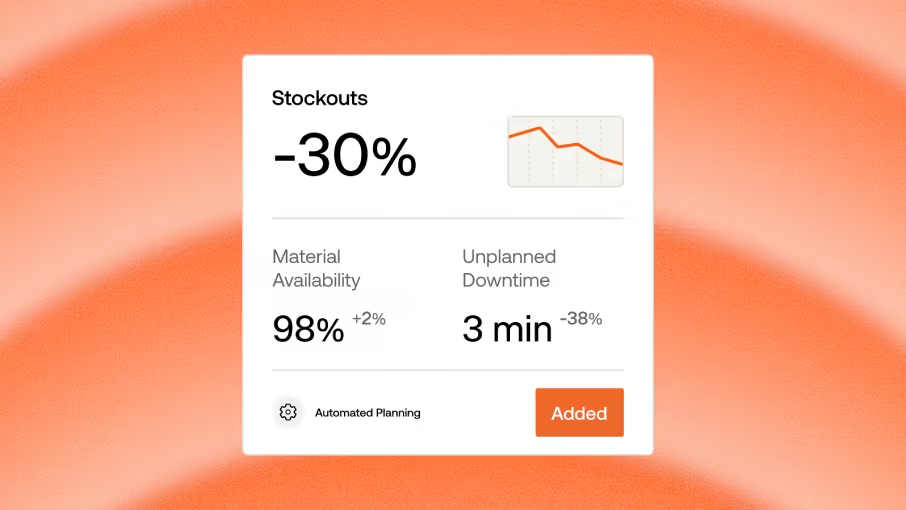
The impact is measurable and it compounds. Faster decision cycles reduce the window in which disruptions become crises. Improved on-time delivery performance strengthens customer relationships and protects revenue. Reduced manual effort frees up experienced operators to focus on strategic problems rather than operational noise. And perhaps most importantly, orchestration restores control precisely where it matters most—at the moment a decision needs to be made, not hours or days after the window has closed.
This is where supply chain advantage is now defined. Not by how much you can see. Not by the sophistication of your dashboards or the breadth of your data feeds. But by how quickly and precisely your organization can act when conditions change—and how consistently you can do it at scale, across every tier of your network.
The manufacturers building that capability today are not just solving an operational problem. They are creating a durable competitive advantage that will be very difficult to replicate.
The question is no longer whether visibility is enough. We know it isn’t. The question is whether your organization is ready to close the gap.
Ready to see it on your data?
We will show you exactly where the gap lives in your network and what closing it looks like in practice.
Let's talk!